Why Every High-Performer Should Have a Daily Score
Tags: Productivity, Performance, Chief Exec
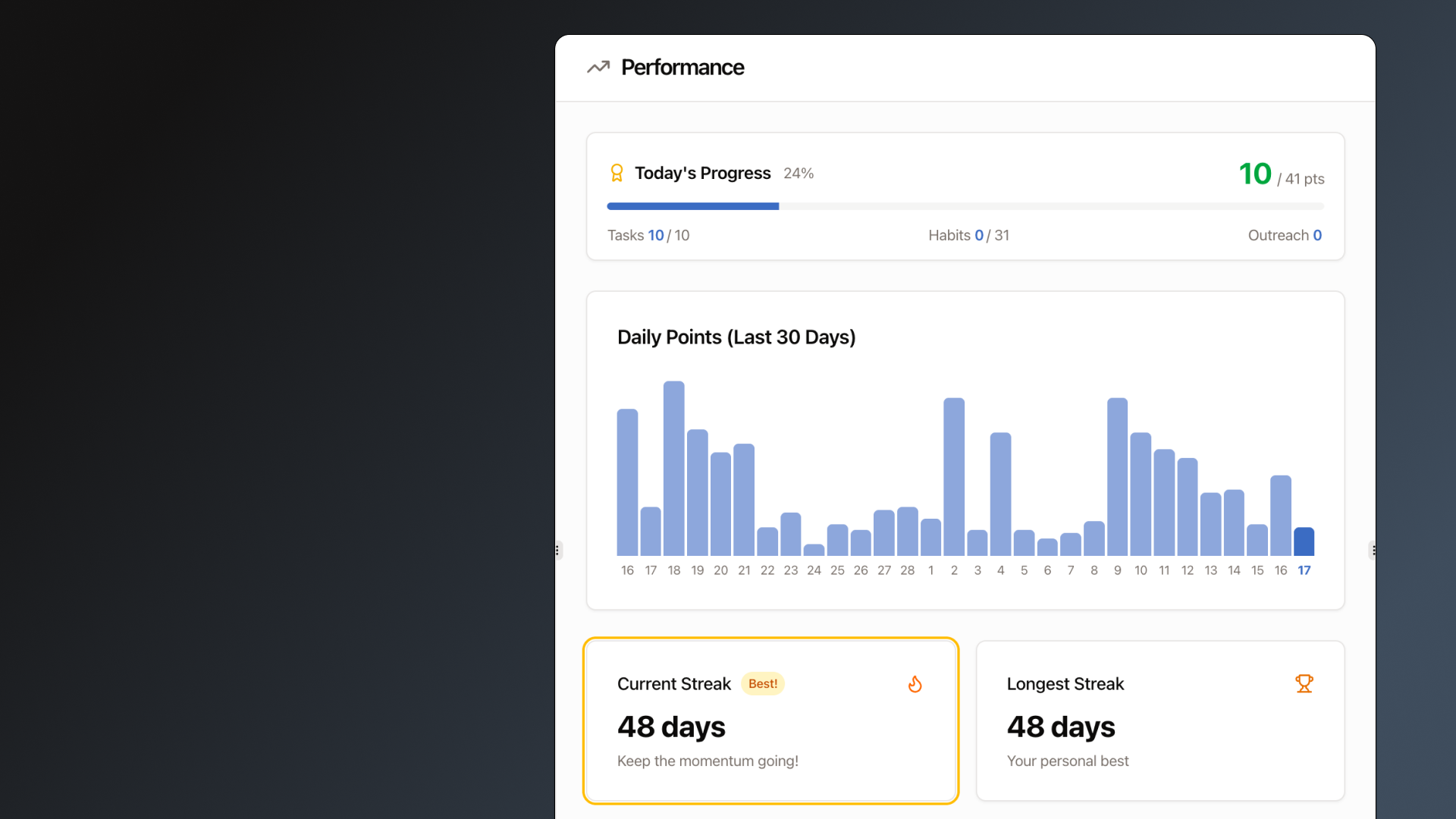
There's a principle in every competitive domain worth paying attention to: the best performers obsess over their numbers.
Not just outcomes — not just "did I win or lose" — but the inputs. The reps. The habits. The leading indicators that produce results weeks or months down the line.
An elite cyclist tracks power output and heart rate variability, not just race results. A professional trader tracks decision quality, not just P&L. A serious athlete knows their resting heart rate, their sleep quality, and their training load — before they look at their standing in the league.
They do this because they understand something most people don't: performance is a system, not an event. And systems need to be measured.
The problem most of us have
Most high-performing people in everyday life — executives, founders, ambitious professionals — operate without any meaningful performance data.
They have outcomes. Revenue. Promotions. Project completions.
But outcomes are lagging indicators. By the time you see them, the behavior that created them (or didn't) was weeks or months ago.
What they don't have is visibility into the inputs: the daily habits, the consistency, the quality of their attention, the relationships they're maintaining. The things happening right now that will determine results later.
So they work hard, hope for the best, and when something goes wrong, they have no idea which variable broke down.
What a daily score changes
Chief Exec's daily score is built around the things you can actually control. Three categories contribute right now:
Habits are worth 1 point each. Every habit you complete adds to your day. Simple, consistent, compounding.
Tasks are worth 1 to 10 points, depending on what you assign. A routine email might be a 1. Finishing a proposal you've been putting off might be a 9. You decide what your work is worth.
Outreach works the same way — 1 to 10 points per person, based on the weight you've given to that relationship. Staying in contact with the people who matter most counts as work, because it is.
There's no cap on the score. If you complete 12 habits, finish three high-value tasks, and follow up with two important contacts, you earn every point. The ceiling is whatever you've built into your system.
That's intentional. This isn't a fixed rubric where 100 is perfect and anything less is failure. It's your system, scored on your terms.
As Rocky says in Creed: it's you against you.
The only number that matters is whether today looks better than yesterday — and whether this week looks better than last.
What the chart actually tells you
When you can see 30 days of daily scores plotted as a line, you stop thinking about today and start thinking about trends. You see the week you fell apart. You see the quiet two-week streak you'd forgotten about. You see the pattern of how your Mondays compare to your Fridays.
Here are the kinds of things people discover when they look at their performance as a data series:
"My scores are high during travel weeks, then crash when I return." You're operating on adrenaline, not systems. The crash is the system returning to its real baseline.
"There's a clear dip every Thursday." What happens on Wednesday nights? This is worth investigating.
"My best weeks are when I complete my morning habits before 9am." The habits aren't just the thing you're tracking — they're the signal for everything else.
"I had a three-week stretch in February I barely remember — but it was my best month of the year." Consistency builds momentum. You can't feel it in the moment. You can only see it in the chart.
Without the chart, these insights don't exist. They're invisible. You feel the effects, but you can't trace them back to their source.
The psychology of visual progress
There's something that happens when you see progress charted visually that doesn't happen when you see it as a raw number.
Numbers are abstract. A score of 78 today means something different than a score of 78 that follows a 55, a 62, and a 70. The trend matters more than the absolute value.
Seeing your line move upward is intrinsically motivating in a way that no goal-setting framework can replicate. It's not the score — it's the direction. It's evidence that what you're doing is working.
Conversely, seeing your line drop gives you actionable urgency without guilt. It's not a judgment — it's data. Something in your system changed. What was it?
This is the difference between being reactive to how you feel and being responsive to how your system is actually performing.
The compound effect, made visible
James Clear wrote about marginal gains — 1% better every day compounds significantly over time. It's a powerful idea that almost nobody actually experiences, because the improvement is invisible at the individual moment.
When you're 1% better today than yesterday, you don't feel it. The human nervous system can't detect 1% differences. What you can detect is a gradual upward slope on a 30-day chart.
The chart makes the compounding visible. And when you can see it, you believe in it. And when you believe in it, you protect it.
A two-week streak suddenly has meaning. You don't want to break it — not because of a rule, but because you can see it right there, and you know how long it took to build.
Where this is going
Right now the score reflects three things: habits, tasks, and outreach. That's a meaningful foundation — these are arguably the most direct inputs into daily performance.
But the plan is to expand the point system across every module in Chief Exec. Workouts. Meals. Goal progress. Reflections. Reviews. All of it, with point values you set yourself, so you get to decide what a complete day looks like for you.
The philosophy stays the same: no universal standard, no fixed ceiling, no comparison to anyone else. Just you, your system, and the honest question of whether you're getting better.
What you can see, you can improve
Chief Exec's performance dashboard isn't a productivity gimmick. It's an attempt to give ordinary people the same kind of performance visibility that elite performers have always had — applied to life, not just work.
Because you can't manage what you can't measure. And most of us have been flying blind.
Start tracking. Look at the chart. Give yourself 30 days.
What you'll find is that the chart doesn't just show you how you've been doing. It shows you who you've been — and what you're actually capable of.