Progress-as-a-Service
Tags: Startups, Strategy, NoCode

"In wartime, by contrast, the company typically has a single bullet in the chamber and must, at all costs, hit the target. The company's survival in wartime depends upon strict adherence and alignment to the mission." — Ben Horowitz
For the past several weeks across VC Twitter, much has been written and much pontificating has been done about what it means to be a "wartime CEO." The question isn't complex. Most businesses in this era of uncertainty have a singular mandate: survive.
Though the execution is difficult, the objective is crystal clear right?
Maybe… but maybe not. While ultimate survival is certainly the first order objective, smart leaders are looking further. They're asking themselves "how does my company not only survive, but thrive and maybe even grow despite the uncertainty?" They've acknowledged the systemic risks, but they're also looking to see where there may be opportunity. The macro economy has given us all lemons. Smart leaders are asking themselves how to make lemonade.
For most companies, headcount costs are their single largest expense. And, with the economic downturn caused by Covid-19, many businesses have had to lay off or furlough key personnel. Others have slashed hiring plans, or cancelled them altogether.
Layoffs are amongst the toughest decisions a leader has to make. These are real people, with real families, and now real uncertainty.
While these moves may be necessary for company survival, the loss of talent and loss of focus has an obvious disruption to growth. Survival is clearly objective #1, but growth is a close second. So how do you grow when you've had to reduce headcount or stop hiring? How does your company keep building when the people you would have relied on to do the building are no longer with the company, or aren't going to be hired in the first place?
Buy wins, not players
"Your goal shouldn't be to buy players… your goal should be to buy wins. And, in order to buy wins, you need to buy runs."
Headcount is the largest expense for most companies because it is assumed that businesses need to add headcount in order to grow. Many companies see growth as an equation "X number of inputs should equate to Y revenue." And it is further assumed that inputs equals people on your payroll that you have to pay every two weeks.
But what if it didn't mean that at all? What if there was a different way to get similar output but without all the payroll costs?
As the Moneyball clip shows, the majority of the Major League Baseball braintrust believed in a certain equation for winning: getting great players on your roster. The problem was that what constituted a "great player" was generally agreed to by every other team, and thus the market for those players became very expensive, and unaffordable for teams like the Oakland A's.
Confronted with that reality for the umpteenth time, the A's started examining how games are won through a more holistic lens. The resulting thesis of player identification — buy wins, not players — allowed them to put together a winning team at a fraction of the payroll of competing teams like the NY Yankees.
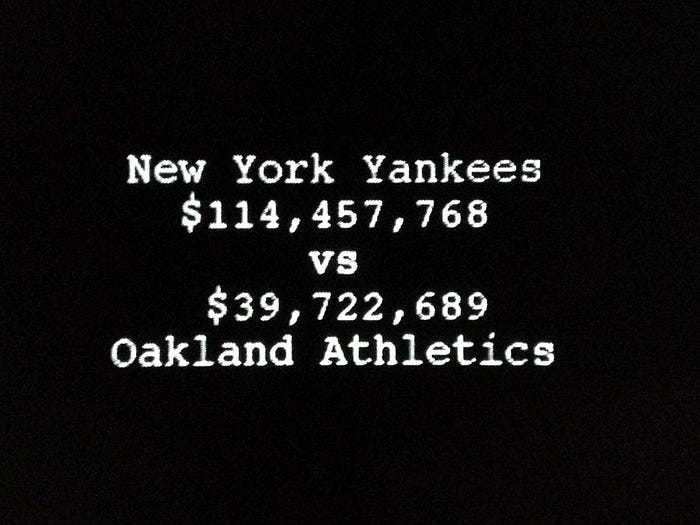
To be clear, the Oakland A's and every other MLB team would certainly have liked to have the $100M+ payroll. Spending more money on better players is how things had been done in baseball "for a hundred years", but the A's didn't have the bankroll to do it. The lack of capital was a forcing function, and as a constraint it allowed the A's management to see what other teams missed.
We are ALL the Oakland A's
In today's macro economy, plagued by uncertainty, we are ALL the Oakland A's to one degree or another. As wartime CEOs, we have to ask ourselves, "how do I continue to put a competitive team on the field, but in a way that I can afford? How does my company play Oakland A's baseball?"
We built Version 1 so you and your team can answer that question.

A consulting firm focused on NoCode development that allows businesses to run faster, leaner, and more profitably.
In a nutshell, we're building a way for tech companies to play Oakland A's baseball. We've observed the growth in the NoCode space, and our team and structure brings together experts across various software and services. Most importantly, we've figured out how to deliver the values of NoCode development to companies on a consulting basis, saving them the high cost and time overhead of hiring.
Here's how we operate:
- Lead/Expert Model: All Version 1 engagements are staffed by a "Project Lead" responsible for scoping the project, managing the overall deliverables, and handling communication. Meanwhile, one or more "Experts" will actually be in the trenches building the solution. This setup optimizes for speed of project completion, and allows your needs to always be met by a person who is expert in that particular software or type of solution.
- Outcome Driven: Often, consulting engagements are plagued by overcomplexity, scope creep, change-orders, extended timelines and high costs. These are all bad outcomes that can be avoided by focusing on small scope, short duration projects, lasting less than two weeks, and featuring clear deliverables and pricing.
- Future Proof: NoCode is here to stay. As the tools progress and more services come online, the ability to "build" will only get more and more powerful. As a result, companies that adopt the NoCode philosophy will be able to much more easily upgrade their operations in the future.
- Fully Documented: Documenting NoCode solutions is really difficult when work is spread across platforms, across logins, and when many people have access to the tools and the power to modify them, etc. It's so difficult that we decided to turn it into a core component of our service. While the power of NoCode is using myriad systems combined intelligently to create powerful solutions, that power comes with even more responsibility to document how everything works, why it works the way it does, and why key decisions were made. Each Version 1 project comes with full documentation including written explanations, screenshots, and video.
You can't go broke taking profits
Here's the best part: running your company faster, leaner, and more profitably is a good idea all the time. While this is a great benefit right now due to the macro economic climate, smart leaders who get results from this new thinking will reap benefits well into the future. What we'll likely see is a shift toward a Progress-as-a-Service model.
Why Version 1?
Peter Thiel's seminal work Zero to One describes the difference in complexity in going from nothing to something. Zero is the default state. One is the built state.
That's what we do here: we create the built state.